
Overview: Different Types of Birth Control
- Mahi Basra
- Jul 8, 2022
- 2 min read
With the recent Supreme Court decision regarding Roe v. Wade, it is imperative that women are aware of different birth control options available to them as part of reproductive healthcare. There are several types of birth control and many different uses ranging from hormonal imbalances, acne to pregnancy prevention. Patients should always discuss their options with their gynecologist to find the best birth control option that will work for them.
Hormonal birth control works by releasing tiny amounts of estrogen and progesterone into the patient’s bloodstream, mimicking pregnancy hormones. This “tricks” the body into thinking that the patient is already pregnant and stops the release of an egg during menstruation. Forms of hormonal birth control include the pill, a shot every 90 days, a ring that is inserted near a patient's cervix, a patch, or IUD. Pros and cons of each type of hormonal birth control are listed below.
Type of Hormonal Birth Control | Description | Pros | Cons |
The Pill | 91-99% effective at preventing pregnancy, most well known form of birth control | Can stop at any time Does not need to be inserted Reduces PMS symptoms Treats acne or irregular periods | Must be taken at same time every day May increase risk of blood clot or stroke depending on risk factors May cause mood swings or depression |
The Shot | Injection is performed every 90 days 94-99% effective | Reduces PMS symptoms Do not have to use every day | Visit OB/GYN every 12 weeks Needles may be uncomfortable Side effects such as: nausea, headache, weight gain |
The Ring | Soft ring inserted into patient’s vagina near cervix, releases estrogen and progesterone 91-99% effective | Lasts 3 weeks after insertion Reduced PMS symptoms Reduces acne Prescription, can insert it yourself | Side effects: breast tenderness and headaches Must remember to put in ring every 3 weeks Higher risk of UTI |
The Patch | Patch is placed on skin which releases hormones into blood stream 91-99% effective | Must be replaced once a week Mild severity side effects | Side effects: nausea, headache, skin irritation, breast tenderness Must remember to replace at same time every week |
The IUD | Inserted into patient’s uterus by OB/GYN 99% effective | Most effective type of birth control Can be used up to 7 years Light to no PMS cycle Less severe symptoms due to lower hormone dose | Can completely stop period Must be inserted by physician Expensive |
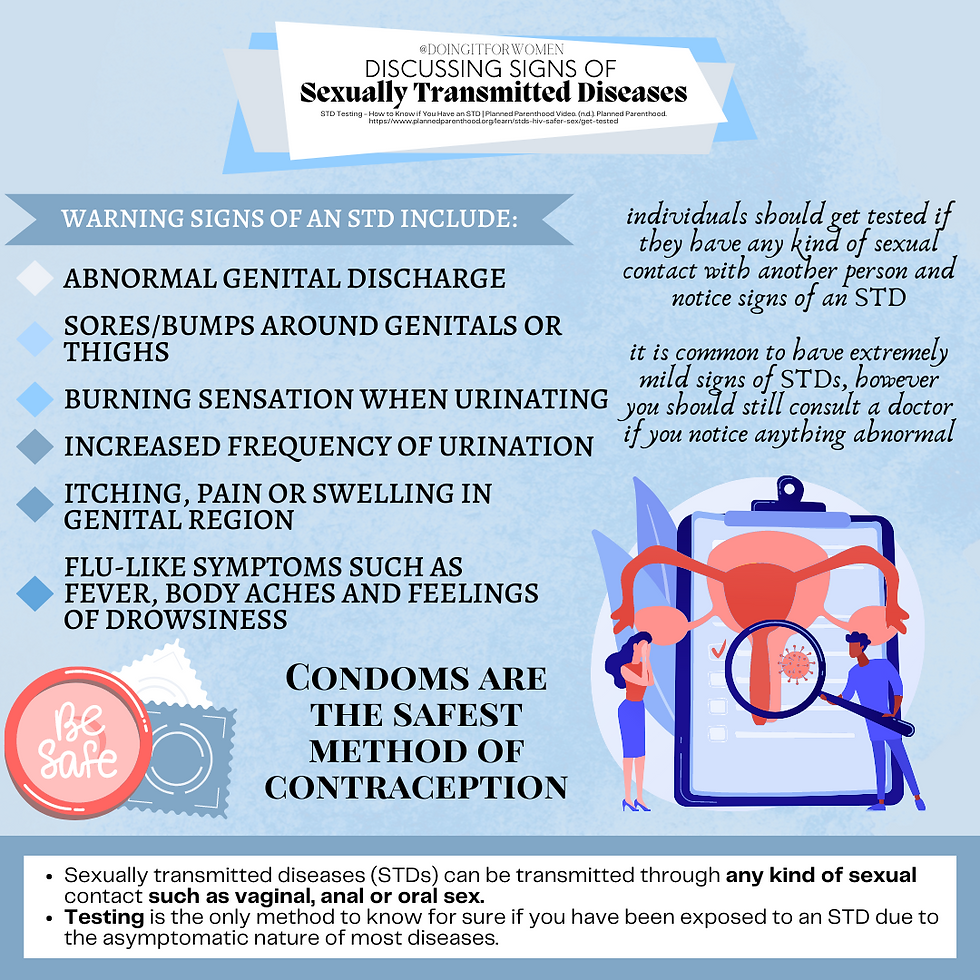
For patients that do not want to interfere with their hormones, there are other non-hormonal birth control methods available. The barrier method or condoms have a 95-97% effective rate and are often recommended to be combined with hormonal birth control. The sponge is another option which is a disc coated in spermicide that can be inserted into the patient’s vagina before sex. This blocks access to the cervix and kills any sperm that may try to enter with an 80% effectiveness. The diaphragm is a silicone disc that is coated with spermicide and inserted into the patient’s vagina. It has an 88% effectiveness rate and is hypoallergenic. The diaphragm can be left in for about 24 hours. The copper IUD is another option that is very similar to the hormonal IUD. However, instead of releasing hormones, the copper detects sperm and either deters them or kills them. This method is over 99.9% effective.
References:
Kaur, A. (2022, June 27). Types of birth control: Pros and cons. The Woman's Clinic. Retrieved July 7, 2022, from https://www.arobgyn.com/types-of-birth-control-pros-and-cons/


Comments